
How to Choose Stainless Bolts in 2026?
Choosing Stainless Bolts in 2026 requires more than comparing prices, grades, and shiny finishes. A bolt may look identical in a supplier’s photograph, yet perform very differently beside saltwater, cleaning chemicals, or dissimilar metals. The International Stainless Steel Forum reported approximately 58.4 million tonnes of global stainless steel production in 2023. That scale reflects strong industrial demand, but it also creates more choices and more room for specification errors.
This guide explains how to select Stainless Bolts for real service conditions. It considers alloy grade, strength class, thread design, coating, temperature, and installation practice. A2 stainless steel, commonly associated with 304, suits many indoor and general outdoor applications. A4, commonly associated with 316, offers stronger resistance to chlorides and coastal exposure. However, neither grade is automatically suitable for every environment. Crevice corrosion can still develop beneath washers, threads, and trapped moisture.
Standards matter. ISO 3506 defines mechanical properties for corrosion-resistant stainless steel fasteners. ASTM F593 and ASTM F594 provide widely used requirements for stainless bolts, screws, nuts, and washers. Always request mill certificates, test documentation, and traceable batch information from the supplier. A lower purchase price can become expensive after thread galling, seized fasteners, or premature replacement. That lesson is easy to overlook.
The best choice begins with the environment, not the catalogue. Record chloride exposure, load direction, operating temperature, and maintenance access before ordering. Then verify compatibility with washers, nuts, and connected metals. Even experienced buyers should review the specification twice. Small details decide long-term reliability.
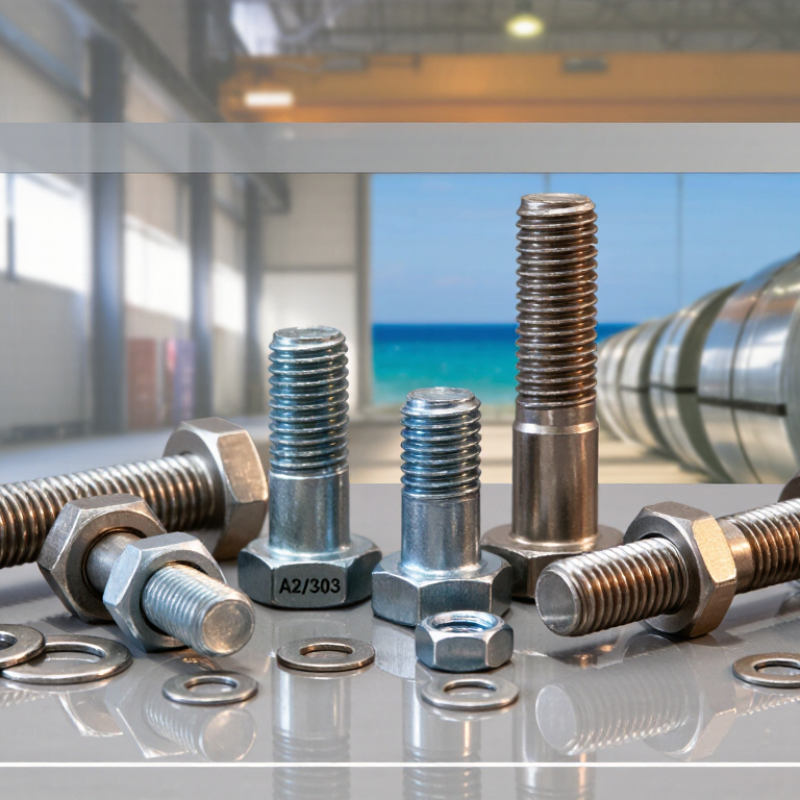
What Stainless Steel Bolts Are and Why Material Choice Matters
How to Choose Stainless Bolts in 2026?
Stainless steel bolts are fasteners made from iron-based alloys containing chromium. Chromium forms a protective oxide film on the surface. This film helps resist rust when oxygen repairs minor damage. Nickel, molybdenum, and nitrogen can improve ductility or chloride resistance. The material is not rust-proof. That distinction matters. Field inspections often reveal corrosion where moisture remains under washers or inside threads. A coastal railing needs different protection than a bolt inside a dry machine room.
Choosing the alloy means matching chemistry to exposure, load, and temperature. Austenitic grades such as 304 suit many indoor and mild outdoor applications. Grade 316 usually performs better near seawater, de-icing salt, and chemical splash. Still, 316 is not automatically stronger. Engineers must check tensile strength, thread condition, preload, and joint design. Stainless threads can gall during fast tightening. Controlled torque and suitable assembly methods reduce this risk. This detail is often missed.
In 2026, traceability deserves attention. Check dimensions against the drawing, then review markings and supplier test documents. Certificates should identify chemical composition, mechanical properties, heat treatment, and applicable standards. Do not select bolts by appearance alone. A polished surface can hide unsuitable material. Temperature cycling and contact with dissimilar metals also deserve review. I have seen clean-looking fasteners fail after water remained beneath a washer. That failure changed my inspection checklist. Real exposure data may still be limited.
How to Choose Stainless Bolts in 2026? - What Stainless Steel Bolts Are and Why Material Choice Matters
| Stainless Steel Grade | Typical Chemical Composition (% by mass) |
Magnetic Behavior | Corrosion Resistance | Typical Applications | Main Selection Considerations |
|---|---|---|---|---|---|
| 304 / 304L | Chromium: 18.0–20.0 Nickel: 8.0–10.5 Molybdenum: not normally specified Low-carbon version: carbon ≤0.03 |
Generally non-magnetic when annealed; cold working may create some magnetism. | Good resistance to atmospheric moisture, many mild chemicals, and indoor or general outdoor service. Less suitable for high-chloride environments. | General construction, machinery, food-processing equipment, indoor fixtures, and ordinary outdoor assemblies. | A practical general-purpose choice where chloride exposure is limited and cost control is important. |
| 316 / 316L | Chromium: 16.0–18.0 Nickel: 10.0–14.0 Molybdenum: 2.0–3.0 Low-carbon version: carbon ≤0.03 |
Generally non-magnetic when annealed; cold working may create some magnetism. | Better resistance than 304 to chlorides, salt spray, and many industrial chemicals because of molybdenum. It is not immune to pitting or crevice corrosion. | Marine hardware, coastal structures, chemical-processing equipment, wastewater systems, and high-humidity installations. | Choose when chloride exposure, coastal conditions, or chemical contamination makes 304 riskier. The low-carbon version is preferred where welding may affect corrosion resistance. |
| 410 | Chromium: 11.5–13.5 Nickel: generally ≤0.75 Molybdenum: not normally specified |
Magnetic. | Moderate corrosion resistance in mild, dry, or lightly corrosive environments; lower resistance than 304 and 316 in chloride exposure. | High-strength machine parts, valves, pumps, automotive components, and applications requiring heat treatment. | Useful when hardness, wear resistance, and strength are more important than maximum corrosion resistance. Confirm the required heat-treated condition. |
| Duplex 2205 | Chromium: approximately 22 Nickel: approximately 5–6 Molybdenum: approximately 3 Nitrogen: approximately 0.08–0.20 |
Magnetic because it has a ferritic-austenitic structure. | Very good resistance to chloride stress-corrosion cracking and pitting when correctly specified and processed. | Offshore equipment, desalination systems, chemical processing, pressure systems, and demanding marine service. | Consider for severe chloride exposure or higher mechanical demands. Availability, forming requirements, and installation procedures may be more restrictive. |
Stainless Bolt Selection Checklist
| Decision Dimension | What to Check | Why It Matters |
|---|---|---|
| Environment | Humidity, salt spray, chlorides, chemicals, temperature, and exposure to standing water. | Corrosion resistance depends on the actual service environment, not only on the word “stainless.” |
| Strength and Load | Required tensile strength, proof load, shear load, fatigue, joint preload, and service temperature. | A corrosion-resistant grade may not provide the required mechanical performance in every condition. |
| Fastener Standard | Thread form, diameter, pitch, length, head style, tolerance, and the applicable ASTM, ISO, or national standard. | Correct dimensions and standard designation help ensure interchangeability and verified performance. |
| Galvanic Compatibility | Contact between the stainless bolt and aluminum, carbon steel, zinc, or other dissimilar metals. | Moisture and dissimilar metals can accelerate galvanic corrosion; suitable isolation may be required. |
| Installation | Recommended torque, lubrication, thread condition, washer use, and risk of thread galling. | Austenitic stainless threads can gall, especially during high-speed or dry installation. |
| Traceability | Material certification, heat or lot identification, inspection records, and dimensional verification. | Documentation confirms that the supplied bolts match the specified grade and requirements. |
Note: Chemical composition ranges are representative values commonly associated with these stainless steel grades. Exact limits, mechanical properties, fastener classes, and acceptance requirements depend on the applicable product standard and specified condition.
Related Posts
-
China Top 10 Stainless Bolt Manufacturers?
-
2026 Best Stainless Torx Screw Options for Your Projects?
-
2026 Best Stainless Torx Screw Options for Global Buyers?
-
Best Stainless Carriage Bolt Types for Your Projects?
-
What is a Mushroom Head Carriage Bolt and Its Uses?
-
2026 Top Furniture Fastener Buying Guide for Global Buyers