
Top 10 Stainless Carriage Bolt Types for Global Buyers
A carriage bolt may look simple: a smooth domed head, a square neck, and threads ready for a nut. Yet global buyers must match the bolt to its material, dimensions, installation surface, and exposure conditions. A square neck can grip timber or a prepared hole, while the rounded head leaves fewer sharp edges exposed. Small details matter.
The market context is substantial. World Stainless Association’s Stainless Steel in Figures 2024 reports 58.4 million tonnes of global stainless steel production in 2023. That figure covers stainless steel broadly, not carriage bolts specifically, but it shows the scale of the material supply behind many industrial products. For technical checks, ASME B18.5 addresses carriage-bolt dimensions, while ASTM F593 covers stainless steel bolts, screws, and studs. Buyers should still confirm the applicable grade, strength condition, coating, and documentation with suppliers. Standards do not replace application review.
This guide compares ten Stainless Carriage Bolt types through practical buying questions: Which head and neck suit the joint? What stainless grade fits the environment? Are the thread, length, and tolerances clearly specified? A coastal railing, a timber deck, and a food-processing fixture may need different choices. Not interchangeable. There is no universal “best” bolt, and supplier descriptions can leave important details unclear. That is worth questioning. Careful comparison helps buyers request verifiable specifications before placing an order.
Stainless Carriage Bolts: Design, Components, and Core Features
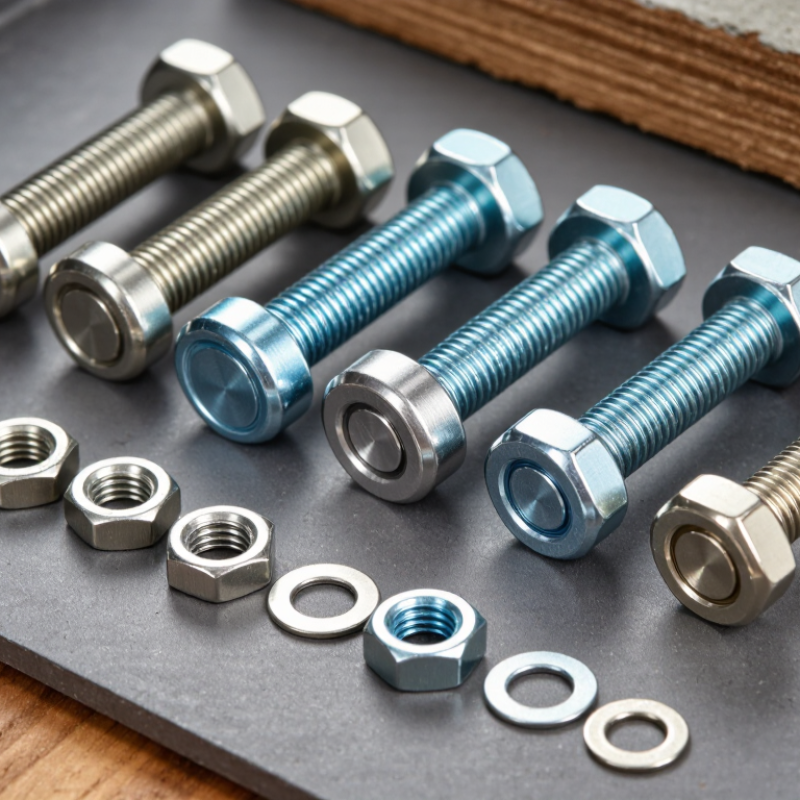
A stainless carriage bolt has a smooth, domed head, a square neck beneath it, and a threaded shank that accepts a nut. The rounded head gives the exposed side a clean finish and reduces snagging. The square neck is the working detail. As the nut tightens, it seats into a matching opening and helps prevent the bolt from turning. Fit comes first.
The neck works best in wood or in a properly sized square hole. In soft timber, oversized holes, or thin sheet, it may not grip securely; the bolt can spin during tightening. A washer can spread pressure under the nut, while controlled tightening helps avoid crushing wood fibers. Check the thread length too. Too little thread leaves poor nut engagement; excess thread can catch nearby parts.
Stainless steel helps resist rust, but the right grade depends on exposure. Grade 304 is commonly considered for general environments, while grade 316 may suit coastal or chloride-rich conditions better. Neither choice makes a connection maintenance-free. Inspect for staining, looseness, and trapped moisture, especially around joints. Small details matter. Sometimes the overlooked issue is the hole, not the bolt.
| No. | Type or Specification | Head and Neck Design | Common Stainless Options | Typical Features and Applications | Buyer Considerations |
|---|---|---|---|---|---|
| 1 | DIN 603 carriage bolt | Domed head with a square neck beneath it | A2 (commonly comparable to 304) and A4 (commonly comparable to 316), subject to supplier specification | A widely recognized metric form. The square neck is designed to resist rotation when seated in a suitably prepared material. | Confirm the applicable edition, dimensions, thread, and material marking; standards and product ranges can vary. |
| 2 | ISO 8677 carriage bolt | Round head with a square neck; metric design | Stainless grades and property classes depend on the applicable product specification | An internationally used metric product standard for cup square bolts with a large diameter head. | Check the current standard and dimensional requirements rather than assuming all DIN 603 dimensions are identical. |
| 3 | ASME B18.5 carriage bolt | Round head and square neck in inch-series dimensions | Stainless steel grades are specified separately from the dimensional standard | Commonly selected for inch-based assemblies and projects designed to U.S. dimensional conventions. | Verify inch thread form, diameter, length, and the material or mechanical-property specification separately. |
| 4 | Short square-neck carriage bolt | Square neck is relatively short beneath the domed head | Often offered in A2/304 or A4/316 stainless steel | Can suit thinner workpieces where a shorter neck is appropriate and the hole or material can engage it. | Match neck length to the actual workpiece; do not rely on the head alone to prevent rotation. |
| 5 | Long square-neck carriage bolt | Extended square neck below the head | Often offered in A2/304 or A4/316 stainless steel | The longer neck can engage thicker or softer materials, helping resist bolt rotation during tightening. | Check neck length, hole dimensions, and material thickness to ensure proper engagement. |
| 6 | Ribbed-neck carriage bolt | Ridges or serrations on the neck instead of a smooth square profile | Grade availability varies by manufacturer and size | Ribs are designed to bite into the mating material and resist rotation, particularly in some wood or composite assemblies. | Confirm the neck geometry and suitability for the substrate; ribs may mark or damage finished surfaces. |
| 7 | Fin-neck carriage bolt | Neck incorporates fins or projections intended to engage the material | Availability in stainless grades is size- and supplier-dependent | Provides a rotation-resisting alternative to a conventional square neck in compatible applications. | Check that the fin profile matches the intended material and installation method. |
| 8 | Partially threaded carriage bolt | Domed head and square neck; an unthreaded shank section remains near the head | Commonly specified in A2/304 or A4/316 where available | The smooth shank can span part of a joint, while the threaded section accepts a nut. | Specify grip length and thread length so the joint clamps correctly without excess unthreaded shank in the nut. |
| 9 | Fully threaded carriage bolt | Domed head and square neck with threads extending along most or all of the shank, as specified | Grade and size availability vary | Offers greater flexibility in nut position and may be useful where a longer threaded engagement is needed. | Confirm the exact threaded length; “full thread” descriptions can differ between product ranges. |
| 10 | High-strength stainless carriage bolt | Typically a standard round head and square-neck form; strength class is specified separately | Some stainless product specifications include A4-80; availability and compliance must be verified | May be selected when a specified higher tensile property is required, subject to the applicable standard and product data. | Do not infer strength from stainless grade alone. Verify the declared property class, standard, and intended design requirements. |
Related Posts
-
China Top 10 Carriage Bolt Suppliers?
-
How to Choose High Quality Carriage Bolt for Your Projects?
-
Top Benefits of Using Stainless Torx Screw for Your Projects?
-

Top 10 Stainless Carriage Bolt Options for Your Next Project
-
Hot Sale Carriage Bolt Buying Tips for Global Buyers?
-
What is a Mushroom Head Carriage Bolt and Its Uses?